Tea, one of the world's three major healthy beverages, is increasingly popular for its unique flavour, pharmacological value and cultural significance. Among its components, the volatile aroma compounds in tea have a great influence on sensory evaluation and overall quality, and these aroma compounds are closely related to tea plant growth conditions — for example, tea plants release specific volatile aroma compounds under stresses such as cold, drought and pest or disease attack. Therefore, accurately detecting the types of volatile aroma compounds is of great significance for rapidly evaluating tea quality and for monitoring tea plant pests and diseases.
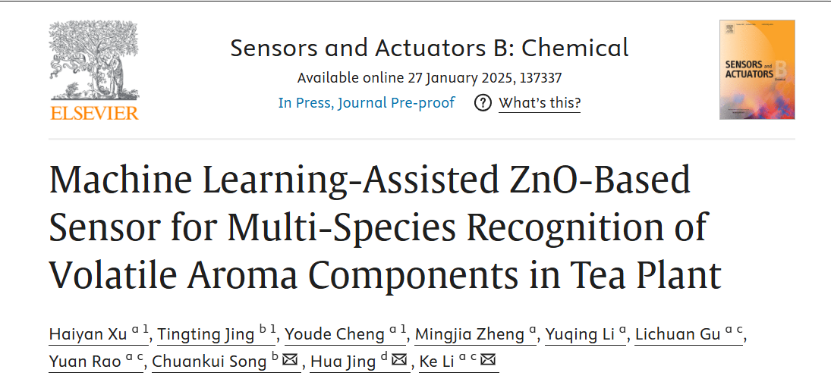
Recently, Professor Li Ke of the School of Information and Artificial Intelligence of our university, together with Professor Song Chuankui of the National Key Laboratory of Tea Plant Germplasm Innovation and Resource Utilization and other collaborating teams, published in the sensor journal Sensors and Actuators B: Chemical a research paper entitled “Machine learning-assisted ZnO-based sensor for multi-species recognition of volatile aroma components in tea plant”. The paper reports for the first time the use of semiconductor gas sensor array technology combined with machine learning algorithms to achieve species recognition and concentration prediction of volatile aroma compounds from multiple tea plant species, providing key technical methods for tea quality identification and for early warning and intelligent control of tea plant pests and diseases.
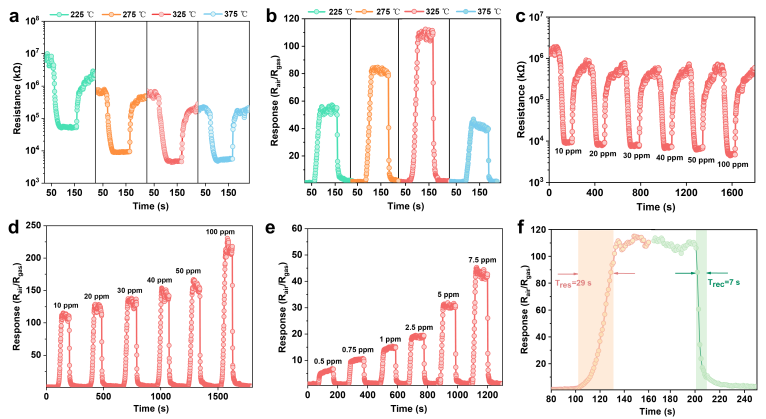
Figure 1. Gas-sensing performance test of the ZnO semiconductor gas sensor for leaf alcohol
In this study, a zinc oxide (ZnO) semiconductor gas sensor was prepared to achieve highly sensitive detection of volatile aroma compounds including leaf alcohol, geraniol, decanal, octanol, phenylethyl alcohol and methyl salicylate. The sensor showed an extremely high gas-sensing response to leaf alcohol: at an operating temperature of 325 °C, the response value to 10 ppm leaf alcohol reached 110, with response/recovery times of 29/7 s and a limit of detection of 0.5 ppm. In addition, the ZnO semiconductor gas sensor showed good cycling stability and long-term stability.
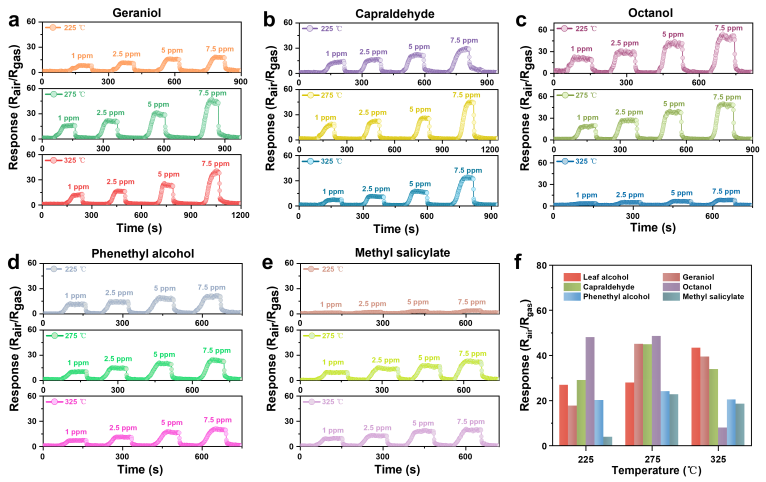
Figure 2. Gas-sensing response tests of the ZnO semiconductor gas sensor to volatile aroma compounds such as geraniol, decanal, octanol, phenylethyl alcohol and methyl salicylate at different operating temperatures
Because the sensor showed good gas-sensing responses to a variety of tea plant volatile aroma compounds, it is difficult for a single sensor alone to accurately identify information such as the species and concentration of aroma compounds. On this basis, the researchers used the principle of regulating semiconductor gas sensor performance through operating temperature to construct a temperature-modulated gas sensor array and, further combining machine learning algorithms such as support vector machines (SVM) and wavelet neural networks (WNN), achieved accurate recognition and concentration prediction of tea plant volatile aroma compounds including leaf alcohol, geraniol, decanal, octanol, phenylethyl alcohol and methyl salicylate. Among them, the recognition accuracy for the volatile aroma compound leaf alcohol reached 95.8% and the concentration prediction accuracy was about 97.8%, while the prediction accuracy for the concentrations of the other volatile aroma compounds also reached more than 96%. The results of this study can provide strong support for tea quality identification and for early warning and intelligent control of tea plant pests and diseases, and are expected to play an important role in tea plant cultivation and tea processing in the future.
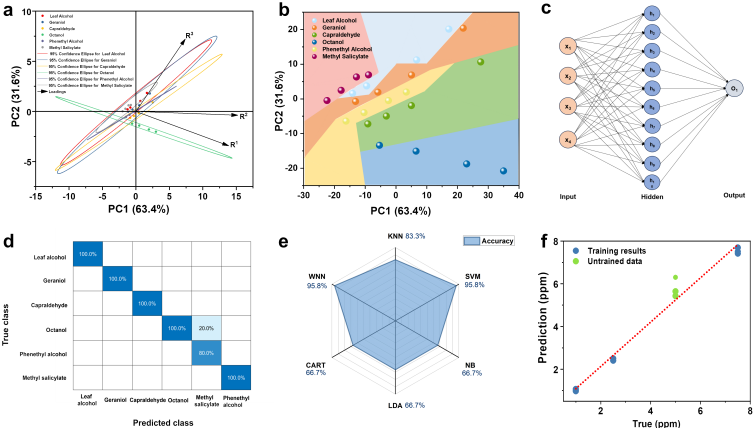
Figure 3. Application of machine learning algorithms in species recognition and concentration prediction of volatile aroma compounds
Anhui Agricultural University is the first affiliation and the corresponding affiliation. Master's student Xu Haiyan of the School of Information and Artificial Intelligence of our university, Associate Professor Jing Tingting of the National Key Laboratory of Tea Plant Germplasm Innovation and Resource Utilization, and doctoral student Cheng Youde of the School of Information and Artificial Intelligence are co-first authors of the paper; Professor Li Ke of the School of Information and Artificial Intelligence, Dr. Jing Hua of the Institute of Botany, Chinese Academy of Sciences, and Professor Song Chuankui of the National Key Laboratory of Tea Plant Germplasm Innovation and Resource Utilization are co-corresponding authors. The research was supported by the National Natural Science Foundation of China, the Anhui Provincial Quality Infrastructure Standardization Special Project, the Open Research Program of the National Key Laboratory of Tea Plant Biology and Resource Utilization, and the Open Research Program of the Key Laboratory of Agricultural Sensors of the Ministry of Agriculture and Rural Affairs. (Text and figures / Li Ke; editor / Guan Zhenyu; pre-review / Song Chuankui; review / Zheng Xuelin)
Paper link: https://www.sciencedirect.com/science/article/pii/S0925400525001121



 LATEST
RESEARCH
LATEST
RESEARCH