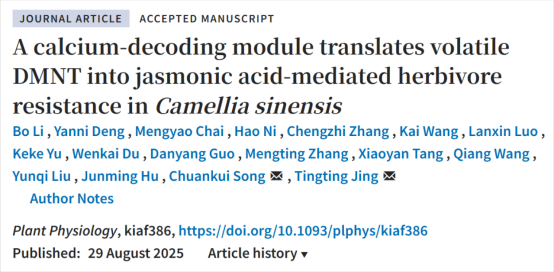
Recently, the team of Professor Song Chuankui at the National Key Laboratory of Tea Plant Germplasm Innovation and Resource Utilization, Anhui Agricultural University, published in the internationally renowned journal Plant Physiology a research paper entitled “A calcium-decoding module translates volatile DMNT into jasmonic acid-mediated herbivore resistance in Camellia sinensis”. It reveals for the first time that (E)-4,8-dimethyl-1,3,7-nonatriene (DMNT), a volatile released by tea plants, can act as a signalling molecule triggering Ca2+ influx in tea mesophyll cells; through activating the Ca2+–CAMTA3–WRKY70–LOX3 signalling cascade it promotes jasmonic acid (JA) accumulation in tea plants and ultimately enhances the pre-emptive insect resistance of receiver tea plants. This study not only enriches the understanding of plant–plant “chemical communication” theory, but also provides an important theoretical basis for the practical application of volatiles in green pest control in tea gardens.

Ectropis obliqua is one of the most important pests in tea gardens, seriously affecting tea yield and quality. When attacked by E. obliqua, tea plants release a variety of volatiles, among which DMNT is one of the most abundantly released compounds (Figure 1). Previous studies have shown that DMNT can not only directly repel adult E. obliqua, but also act as a signalling substance perceived by neighbouring plants to activate the JA pathway and regulate tea plant insect resistance (Figure 1). However, until now, the mechanism by which DMNT is “decoded” into internal plant defence signals has remained unclear.
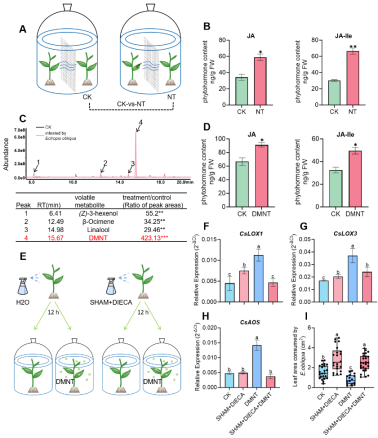
Figure 1. DMNT pre-exposure enhances tea plant resistance to Ectropis obliqua larvae in a JA-signalling-dependent manner
To explore the logical relationship between DMNT and JA accumulation, transcriptome analysis of receiver plants neighbouring pest-infested tea plants revealed that the JA biosynthesis enzyme gene CsLOX3 was highly correlated with the expression of 11 transcription factors. Subsequently, Y1H, EMSA and dual-LUC experiments confirmed that the transcription factor CsWRKY70 positively regulates CsLOX3 expression (Figure 2). Using gene silencing and DMNT exposure experiments, it was confirmed that DMNT induces CsWRKY70, which in turn regulates CsLOX3 expression, promotes JA accumulation and enhances tea plant insect resistance.
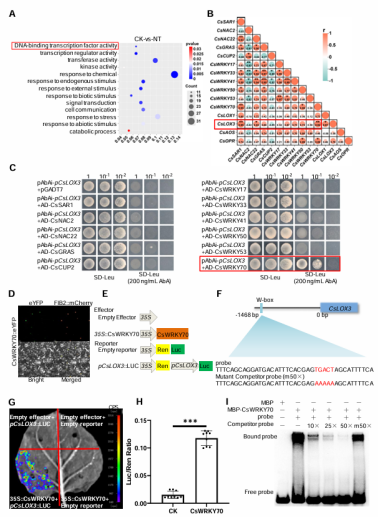
Figure 2. CsWRKY70 directly activates CsLOX3 expression
Having established that the DMNT-induced transcription factor CsWRKY70 can regulate JA synthesis, the next question was how DMNT induces CsWRKY70 expression. To solve this, the team used non-invasive micro-test technology and found that DMNT triggers a transient, massive Ca2+ influx in tea mesophyll cells (Figure 3). On this basis, the team proposed that DMNT transmits the signal downstream through Ca2+. Using Y1H, EMSA and dual-LUC combined with tea plant gene silencing and DMNT exposure, the team found that the calmodulin-binding transcription factor CsCAMTA3 is induced by DMNT and positively regulates CsWRKY70 expression, thereby regulating CsLOX3 and JA synthesis and improving tea plant insect resistance.
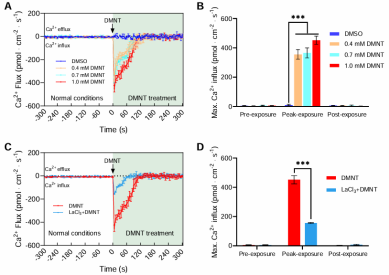
Figure 3. DMNT induces transmembrane Ca2+ influx in tea mesophyll cells
In summary, this study clarified for the first time the molecular mechanism by which the pest-induced volatile DMNT induces JA biosynthesis in tea plants through the Ca2+–CAMTA3–WRKY70–LOX3 cascade (Figure 4). This finding deepens the understanding of how volatiles participate in chemical communication between plants, especially the intrinsic mechanism by which plants decode volatiles, and lays a theoretical foundation for the application of volatiles in green pest control in tea gardens.
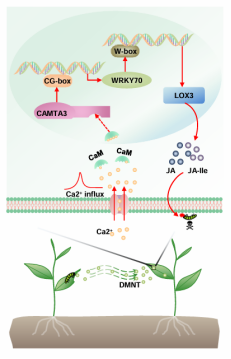
Figure 4. Model of DMNT-induced defence against pests in tea plants
Associate Professor Jing Tingting and Professor Song Chuankui of the National Key Laboratory of Tea Plant Germplasm Innovation and Resource Utilization, Anhui Agricultural University, are co-corresponding authors, and doctoral student Li Bo is the first author. Associate Professor Wang Qiang of the laboratory also participated in the work. The research was supported by the National Key R&D Program and the National Natural Science Foundation of China.



 LATEST
RESEARCH
LATEST
RESEARCH