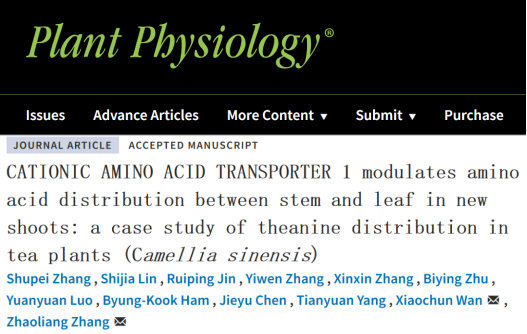
Recently, the team of Professors Zhang Zhaoliang and Wan Xiaochun published in the internationally renowned botany journal Plant Physiology a research paper entitled “CATIONIC AMINO ACID TRANSPORTER1 modulates amino acid distribution between stem and leaf in new shoots of tea plants”. The study revealed the molecular regulatory mechanism of theanine distribution between stem and leaf in tea plant new shoots, providing an important theoretical basis for improving tea quality through molecular breeding and cultivation measures.
Theanine is a non-protein amino acid unique to tea plants. Its content accounts for 40%–70% of the total free amino acids in spring tea, and it is the main substance responsible for the fresh and brisk taste of tea; it has also attracted much attention for health benefits such as relieving anxiety, promoting sleep and enhancing immunity. It is mainly synthesized in tea plant roots and transported to new shoots. However, in tea plant new shoots the theanine content in young stems is 3–10 times that in young leaves (Figure 1). Yet many teas, such as matcha and Lu'an Guapian, use only young leaves as raw material, and the later stages of processing most oolong teas also require “de-stemming”, which is unfavourable for the formation of the umami taste of these teas. Therefore, clarifying the molecular mechanism regulating the distribution of theanine between stem and leaf can promote greater allocation of theanine to young leaves and thereby improve tea quality.
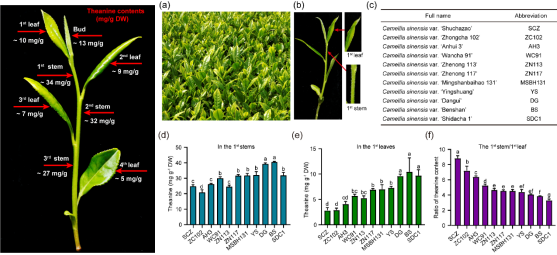
Figure 1. Comparison of theanine content in the first stem and first leaf of new shoots of different tea cultivars
The team found that the stem/leaf ratio of theanine differed among tea cultivars, indicating that the distribution efficiency of theanine between stem and leaf differs among cultivars (Figure 1). Through transcriptome and gene expression analysis, they targeted CsCAT1, a gene encoding CATIONIC AMINO ACID TRANSPORTER 1 that is highly correlated with the stem/leaf ratio of theanine in tea new shoots. By constructing a yeast complementation system, the researchers confirmed not only that CsCAT1 has theanine transport activity, but also that it can transport a variety of other amino acids. Subcellular localization experiments showed that CsCAT1 is localized to the plasma membrane and plays an important role in the inward transport of theanine across the plasma membrane. In addition, CsCAT1 is mainly highly expressed in xylem parenchyma (especially ray parenchyma) and phloem parenchyma cells, suggesting that the gene may participate in regulating the exchange of theanine between xylem and phloem in young stems during transport, while providing a nitrogen source and enabling local storage of theanine (Figure 2).
After Qingming, theanine declines rapidly in leaves while stem content remains stable, so the stem/leaf ratio of theanine rises; at this time CsCAT1 expression in stems is up-regulated 2-fold, with no significant difference in leaves. Further inhibition of CsCAT1 expression in stems using antisense oligonucleotides (asODN) significantly increased leaf theanine content and significantly reduced the stem/leaf ratio. These results indicate that CsCAT1 negatively regulates the accumulation of theanine in leaves by mediating theanine transport in stems, and thus plays a role in regulating the distribution of theanine to leaves.
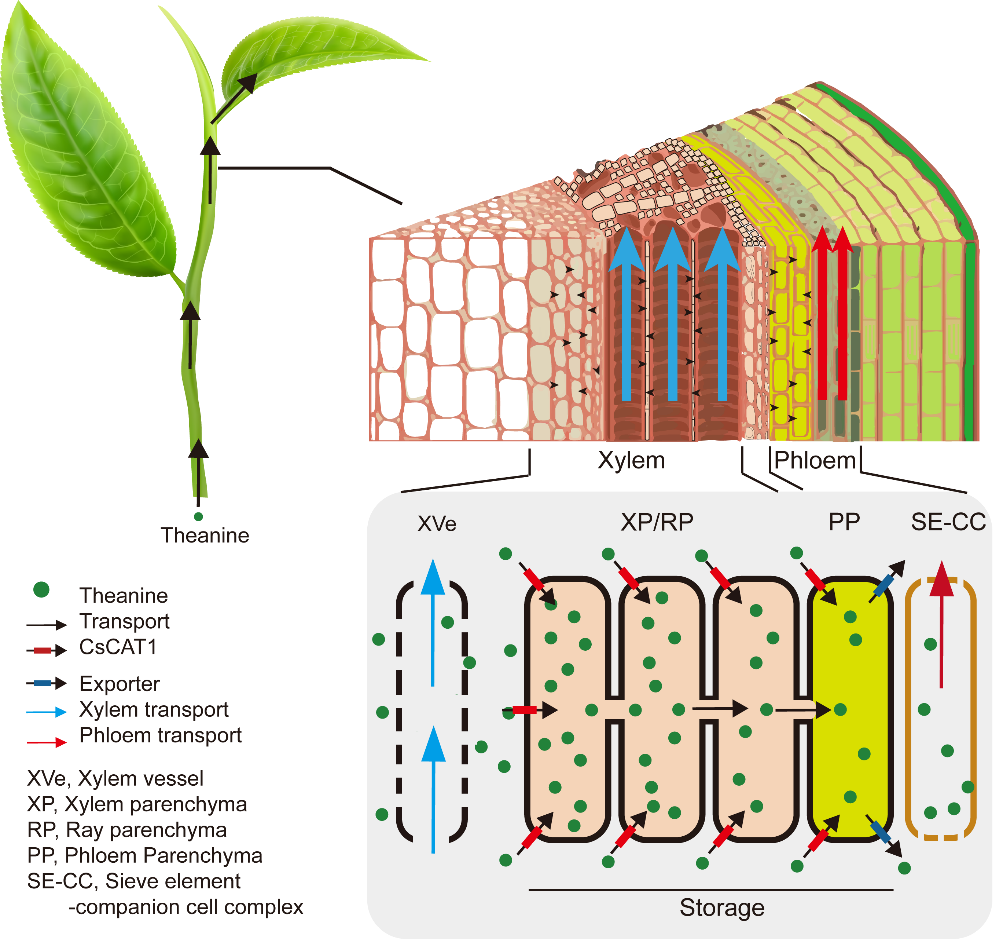
Figure 2. Model of CsCAT1 regulating the distribution of theanine between stem and leaf in tea plants
This study reports the molecular mechanism by which CsCAT1 regulates the distribution of theanine between stem and leaf in tea plant new shoots, providing an important theoretical basis for increasing theanine content in tea.
Professor Wan Xiaochun and Professor Zhang Zhaoliang of the National Key Laboratory of Tea Plant Germplasm Innovation and Resource Utilization of our university are the corresponding authors of the paper, and Zhang Shupei, Lin Shijia and Jin Ruiping are co-first authors. Associate Professor Yang Tianyuan of the Key Laboratory and Professor Byung-Kook Ham of the University of Saskatchewan, Canada, participated in the study. The research was supported by the National Key R&D Program and the National Natural Science Foundation of China. (Text and figures: Zhang Shupei; pre-review: Guan Zhenyu; review: Zhang Zhaoliang)
Original paper: https://academic.oup.com/plphys/advance-article/doi/10.1093/plphys/kiaf255/8162310


 LATEST
RESEARCH
LATEST
RESEARCH