Recently, the team of Professor Wei Chaoling at the National Key Laboratory of Tea Plant Germplasm Innovation and Resource Utilization, Anhui Agricultural University, published in the internationally renowned journal Plant, Cell & Environment a research paper entitled “A Positive Regulator CsPR10-9 Confers Resistance to Anthracnose (Colletotrichum gloeosporioides) Is Negatively Regulated by CsMYB72 in Tea Plants”. The work revealed the molecular mechanism by which the CsMYB72–CsPR10-9 module mediates resistance to Colletotrichum by regulating salicylic acid (SA) and jasmonic acid (JA) signalling pathways, providing important gene resources and new targets for disease-resistance breeding in tea plants.
Anthracnose is one of the most serious fungal diseases of tea plants and seriously affects tea yield and quality. After infection by Colletotrichum, brown or black spots form on tea leaves; these spots rapidly expand and merge, eventually causing extensive tissue necrosis and leaf abscission. However, little is known about the key genes underlying tea plant resistance to anthracnose and the molecular mechanisms they mediate. Therefore, excavating disease-resistance genes and dissecting the defence mechanisms they mediate has important theoretical significance for breeding disease-resistant germplasm.
Through transcriptome analysis, the team found that multiple members of the PR10 family respond to anthracnose stress, with PR10-9 responding most obviously and being induced by the hormones SA and MeJA. Transient silencing of CsPR10-9 enlarged lesion areas in tea leaves, increased reactive oxygen species (ROS) accumulation, decreased antioxidant enzyme (POD and SOD) activities, reduced SA content and increased JA content (Figure 1); overexpression of CsPR10-9 in tobacco reduced lesion area, decreased H2O2 levels and increased POD/SOD activities. The results indicate that CsPR10-9 positively regulates tea plant resistance to anthracnose.
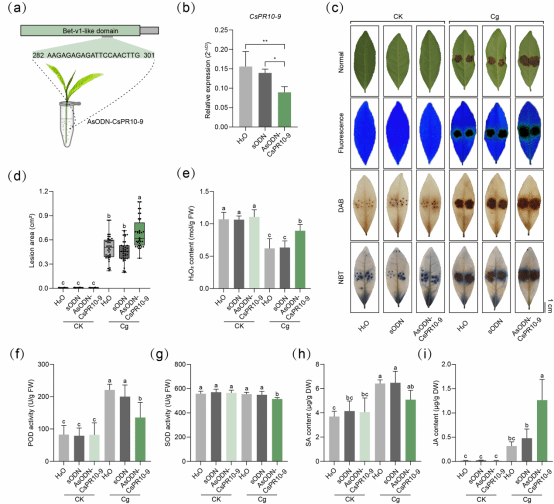
Figure 1. Silencing CsPR10-9 weakens tea plant resistance to anthracnose
The key transcription factor CsMYB72 upstream of PR10-9 was identified; it is also induced by pathogens and SA/MeJA. Yeast one-hybrid, EMSA and dual-luciferase experiments confirmed that CsMYB72 directly binds the MYB binding site in the CsPR10-9 promoter, thereby inhibiting CsPR10-9 transcription (Figure 2). Silencing CsMYB72 led to up-regulated CsPR10-9 expression, reduced lesion size, increased POD/SOD activities, increased SA accumulation and decreased JA content, thereby enhancing tea plant resistance to anthracnose.
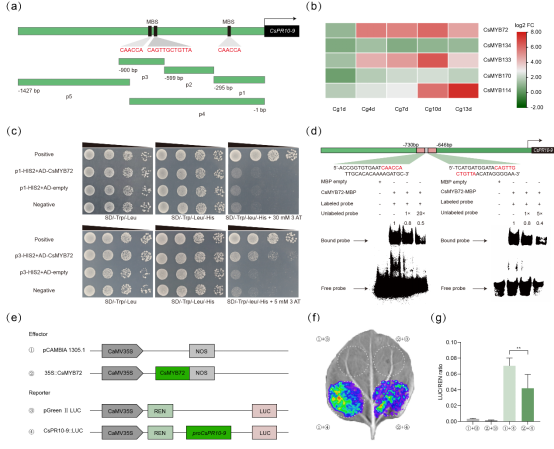
Figure 2. CsMYB72 negatively regulates CsPR10-9 expression
This study screened and confirmed the disease-resistance gene CsPR10-9 in tea plants and dissected how the balance of SA and JA dynamically regulates the antioxidant defence system (ROS scavenging) and hormone levels through the CsMYB72–CsPR10-9 module, thereby regulating tea plant resistance to anthracnose (Figure 3). CsMYB72 and CsPR10-9 can serve as candidate molecular targets for improving tea plant disease resistance through gene editing or breeding approaches and for reducing dependence on chemical pesticides.
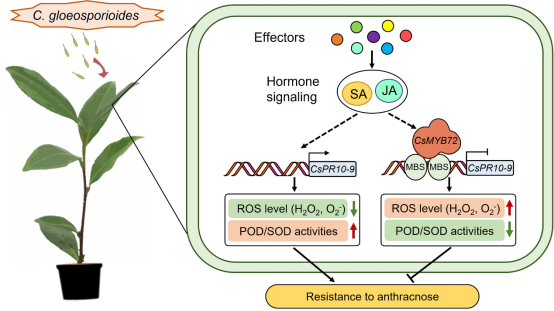
Figure 3. Model of the CsMYB72–CsPR10-9 module mediating tea plant resistance to Colletotrichum
Master's students Tao Yongning, Wang Pengke and Gong Yilin of the National Key Laboratory of Tea Plant Germplasm Innovation and Resource Utilization, Anhui Agricultural University, are co-first authors of the paper, and Professor Liu Shengrui and Professor Wei Chaoling are co-corresponding authors. Associate Professors Zhu Junyan and Hu Jianbing and Lecturer Dong Kun of the Key Laboratory also participated in the study. The research was supported by the National Natural Science Foundation of China.
(Text and figures / Liu Shengrui; editor / Guan Zhenyu; pre-review / Wei Chaoling)


 LATEST
RESEARCH
LATEST
RESEARCH