Recently, the team of Professor Song Chuankui at the National Key Laboratory of Tea Plant Germplasm Innovation and Resource Utilization, Anhui Agricultural University, together with Researcher Ye Meng of the Tea Research Institute of the Chinese Academy of Agricultural Sciences, published in the classic botany journal Plant Biotechnology Journal a research paper entitled “Cold stress-induced (Z)-3-hexenol and thymol enhance cold tolerance of tea plants by activating Ca2+ signaling”. The study established for the first time in tea plants a high-frequency calcium detection system based on leaf protoplasts and revealed the key role of calcium signalling in volatile organic compound (VOC)-mediated cold-tolerance responses in tea plants. Based on this system, two VOCs that significantly enhance tea plant cold tolerance were identified — (Z)-3-hexenol and thymol — and they were shown to enhance cold tolerance by activating intracellular Ca2+ signalling. This technique not only provides an important tool for research on stress-resistance mechanisms in tea plants, but also offers a feasible approach for related studies in other crops that are difficult to transform stably. The functional VOCs identified are expected to become new candidate small molecules for stress-resistance breeding and green crop protection, with important significance for promoting sustainable agricultural development.
VOCs released by plants are important molecules for information transfer between plants and can play a central role in stress warning, defence against stress and reproduction. A large body of research shows that volatiles released by neighbouring plants can help healthy plants improve their ability to withstand abiotic stresses such as low temperature and drought, as well as biotic stresses such as herbivorous insects. Over the past two decades, this phenomenon of signal exchange has been widely observed in many species, reflecting its important ecological function and significance. However, the specific active components of many functional VOCs and their stress-resistance mechanisms still need to be further resolved.
Previous studies suggested that Ca2+ signalling plays a key role in VOC-induced defence responses. Some volatiles can raise intracellular Ca2+ levels and initiate downstream signalling pathways by up-regulating calcium-decoding proteins (such as CaMs, CMLs, CDPKs and CBLs). This study confirmed for the first time that cold-induced VOCs directly participate in and regulate the cold-tolerance response of tea plants by activating the intracellular Ca2+ signalling pathway (Figure 1). Previously, Aratani et al. used transgenic Arabidopsis and the GCaMP3 calcium sensor to show that certain green leaf volatiles can induce a transient increase in intracellular Ca2+ in Arabidopsis, providing a powerful tool for studying the signalling mechanism of VOCs. However, that transgenic fluorescence imaging method relies too heavily on a stable genetic transformation system and high-quality fluorescence imaging, and is not applicable to species with a thick waxy leaf epidermis that are difficult to transform, such as tea plants. Therefore, there is an urgent need to develop a more general Ca2+ detection approach suitable for hard-to-transform plants.
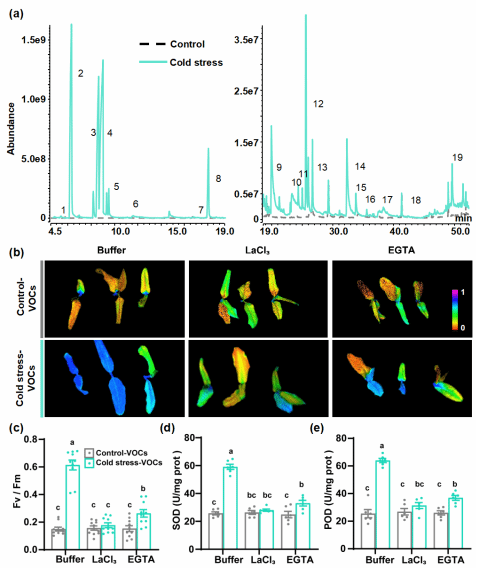
Figure 1. Calcium signalling participates in VOC-induced enhancement of cold tolerance in tea plants
To overcome this technical bottleneck, based on the scientific hypothesis that “VOCs may regulate plant cold tolerance through the Ca2+ signalling pathway”, the team used the calcium-specific fluorescent dye Fluo-8 to establish a second-level, high-frequency Ca2+ detection system in tea leaf protoplasts, enabling real-time monitoring of intracellular Ca2+ dynamics. With this platform, the team screened cold stress-induced VOCs and identified (Z)-3-hexenol and thymol as highly efficient activators of cellular Ca2+ signalling (Figure 2).
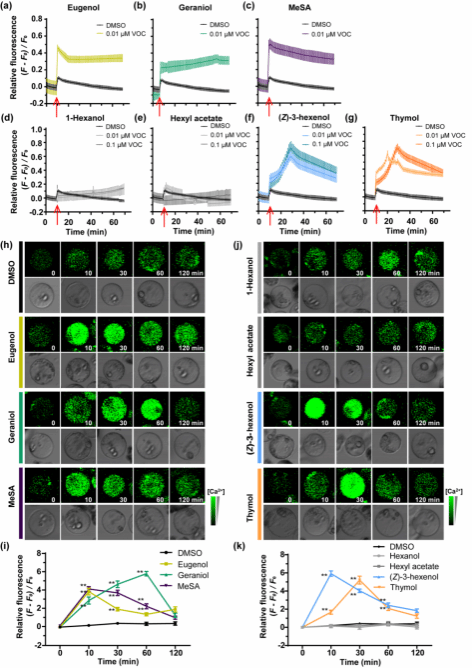
Figure 2. Cold-induced VOCs trigger cellular Ca2+ responses in tea leaf protoplasts
Functional verification experiments showed that after treatment with these two volatiles, the expression of key cold-responsive genes in tea plants (such as CsICE1, CsCBF1 and CsCBF2) was significantly up-regulated, antioxidant enzyme activities (superoxide dismutase, SOD, and peroxidase, POD) increased, photosynthetic system function was better maintained, and tolerance to low-temperature stress was significantly enhanced. Pharmacological inhibition experiments further demonstrated that Ca2+ inhibitors could block the above gene and physiological responses, indicating the necessity of Ca2+ signalling in this process. Through antisense oligonucleotide-mediated gene silencing experiments, the study also identified CsCDPK4 as the key molecule that decodes and transduces VOC-induced Ca2+ signalling into downstream cold-tolerance responses, and its silencing weakened the protective effect conferred by VOCs (Figure 3), thereby clarifying the important position of Ca2+ signalling in VOC perception and cold defence mechanisms in tea plants.
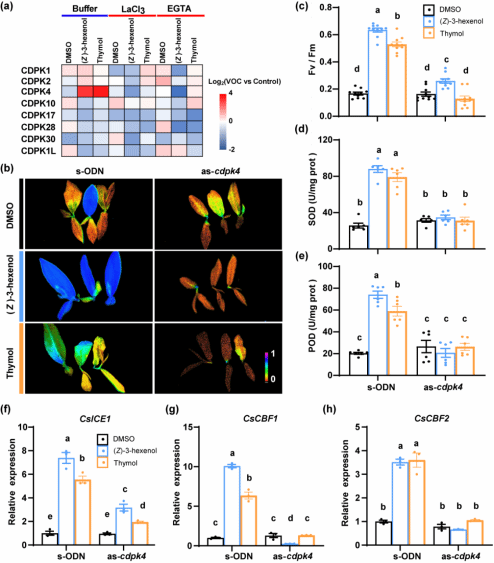
Figure 3. CsCDPK4 plays a key role in (Z)-3-hexenol- and thymol-induced cold tolerance in tea plants
Improving crop low-temperature tolerance has long been one of the important challenges facing modern agriculture. As a natural stress-response mediator, VOCs have attracted much attention in recent years because of their ease of non-contact induction and their potential for green pest control. By integrating chemical ecology and technological innovation, this study fills a key gap in research on the signal transduction mechanism of VOCs under cold stress (Figure 4). The established protoplast Ca2+ detection system effectively overcomes the technical limitations of previous transgenic fluorescent probe-based approaches in hard-to-transform plants, providing not only an important tool for research on stress-resistance mechanisms in tea plants, but also a replicable technical route for similar studies in other crops. The functional VOCs screened with this system can serve as candidate small molecules for crop stress-resistance breeding and green pest control, offering new ideas for sustainable agricultural development.
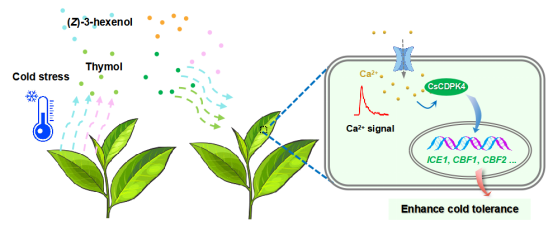
Figure 4. Mechanistic model of cold-induced (Z)-3-hexenol and thymol enhancing tea plant cold tolerance
This research was jointly completed by the National Key Laboratory of Tea Germplasm Innovation and Resource Utilization of Anhui Agricultural University and the Tea Research Institute of the Chinese Academy of Agricultural Sciences. Liu Yuantao, a postdoctoral fellow at Anhui Agricultural University, is the first author of the paper. Professor Song Chuankui and Researcher Ye Meng from the Tea Research Institute of the Chinese Academy of Agricultural Sciences are the co-corresponding authors. Associate Professors Wang Qiang and Jing Tingting from Anhui Agricultural University and Professor Wilfried Schwab from the Technical University of Munich in Germany also participated in the research work. This research was supported by the National Key Research and Development Program, the National Natural Science Foundation of China and other projects.



 LATEST
RESEARCH
LATEST
RESEARCH