Recently, the internationally renowned journal Advanced Science published online a research paper from Professor Xia Enhua's team at the National Key Laboratory of Tea Plant Germplasm Innovation and Resource Utilization, Anhui Agricultural University, entitled “Natural Variation of COLD AND CATECHINS REGULATOR 1 Coordinately Fine-Tunes Cold Tolerance and Tea Quality in Tea Plants”. The study systematically revealed the molecular mechanism by which the novel tea plant gene CCR1 (COLD AND CATECHINS REGULATOR 1) coordinately regulates cold tolerance and catechin accumulation, providing a new perspective for the simultaneous improvement of stress resistance and quality in tea plant breeding.
Low-temperature stress seriously affects tea yield and quality. For a long time, cold tolerance and quality traits in tea plants have been difficult to improve simultaneously, and the genetic coupling mechanism between them has remained unclear. To address this, the team collected 108 core tea germplasm accessions from China and, through two consecutive years of systematic measurement of cold-tolerance phenotypes and of the content of 12 quality-related metabolites, combined with whole-genome resequencing and multi-trait GWAS analysis, mapped the pleiotropic key gene CsCCR1 and functionally confirmed that CsCCR1 positively regulates cold tolerance and catechin accumulation in tea plants.
The study showed that low temperature induces the upstream transcription factors CsLUX and CsKUA1 to directly activate CsCCR1 expression. On the one hand, CsCCR1 directly binds to and activates the expression of key catechin biosynthesis genes such as CsCHS1, CsFLS1, CsSCPL4 and CsSCPL5 and of the novel cold-responsive gene CsELIP1; on the other hand, it forms a transcriptional complex with CsCBF1/3, cascadingly enhancing downstream gene expression and simultaneously increasing cold tolerance and the accumulation of EGCG, EGC and EC. The accumulated catechins act as reactive oxygen species scavengers and effectively alleviate low-temperature oxidative damage to tea leaves. The team also found that an A-to-C missense mutation (Q119P) in the coding region of CsCCR1 enhances the protein's binding ability to CsCBF1/3, so that tea plants with the CsCCR1C genotype have stronger cold tolerance and higher catechin content, providing a new target for marker-assisted breeding.
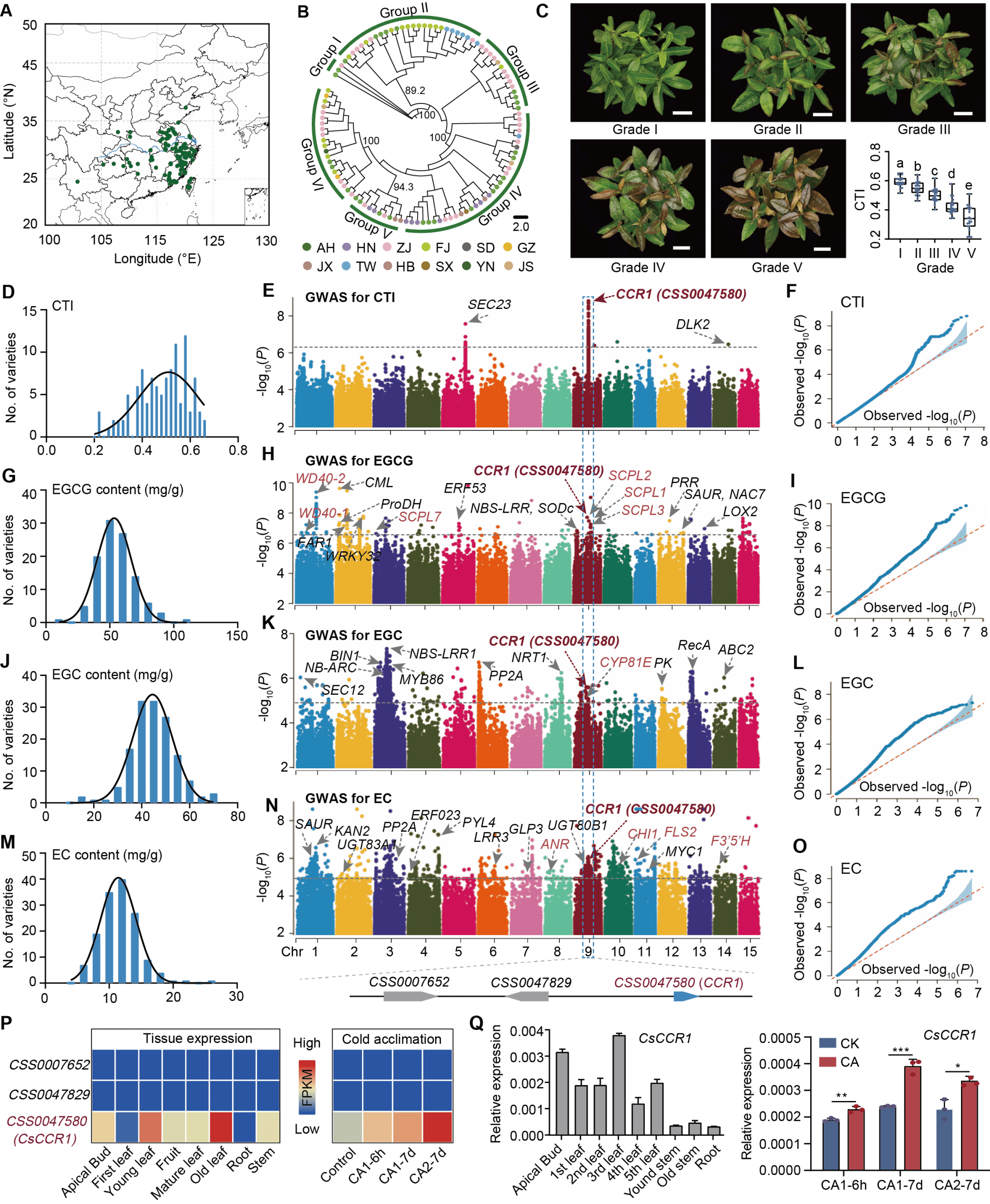
Figure 1. Identification of candidate genes for the coordinated regulation of cold tolerance and catechin accumulation in tea plants
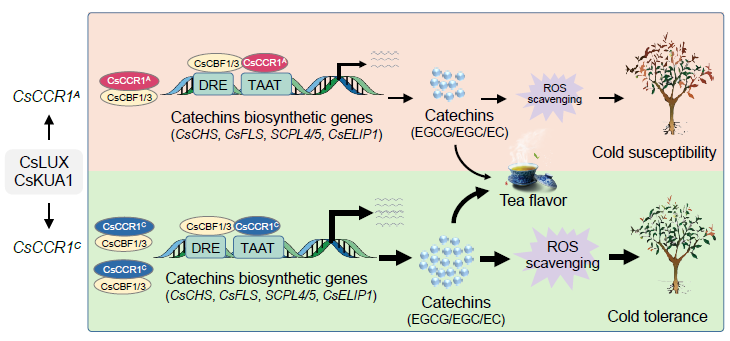
Figure 2. Working model of CsCCR1 coordinately regulating cold tolerance and catechin accumulation in tea plants
Anhui Agricultural University is the first affiliation. Wang Yanli, a doctoral student at the National Key Laboratory of Tea Plant Germplasm Innovation and Resource Utilization, Associate Professor Tong Wei, and Associate Researcher Wu Qiong of the Tea Research Institute of the Anhui Academy of Agricultural Sciences are co-first authors, and Professor Xia Enhua is the corresponding author. Professor Zhang Zhaoliang, Professor Song Chuankui, postdoctoral fellows Zhang Yanrui and Gao Qijuan and Senior Experimentalist Li Fangdong of Anhui Agricultural University, and Researcher Wang Wenjie of the Anhui Academy of Agricultural Sciences also participated in the study. The research was supported by the National Natural Science Foundation of China, the Outstanding Youth Fund of the Anhui Provincial Natural Science Foundation, and the Open Research Program of the National Key Laboratory of Tea Plant Germplasm Innovation and Resource Utilization.
Original paper: http://doi.org/10.1002/advs.76225
Source: National Key Laboratory of Tea Plant Germplasm Innovation and Resource Utilization, Anhui Agricultural University



 LATEST
RESEARCH
LATEST
RESEARCH