Recently, the team of Professor Li Penghui together with Professor Xia Enhua published online in Plant Biotechnology Journal a research paper entitled “Divergent MYB paralogs determine spatial distribution of linalool mediated by JA and DNA demethylation participating in aroma formation and cold tolerance of tea plants”. The study identified MYB transcription factors regulating linalool synthesis in tea flowers and leaves, dissected the molecular mechanism by which these MYB transcription factors cooperate with MYC2 and JAZ proteins during tea processing and in the tea plant response to cold stress, and further found that the DNA demethylation pathway acts on these MYB transcription factors and participates in the regulation of linalool synthesis under cold stress.
Linalool is not only one of the core compounds contributing to tea aroma, but also one of the important volatile substances for tea plants to cope with external stress. The linalool synthesis pathway in tea plants is clear and the key synthase genes have been identified, but its transcriptional regulatory mechanism — especially the regulation of linalool synthesis during tea processing and under cold stress — was still unclear. This study identified two pairs of ancient MYB paralogues, of which CsMYB148/CsMYB193 are specifically expressed in tea flowers, presumably specifically regulating linalool synthesis in flowers, while CsMYB68/CsMYB147 are expressed not only in flowers but also in leaves and stems, presumably participating in linalool synthesis in leaves. Through a series of homologous and heterologous overexpression experiments, the study verified the biological function of these MYB transcription factors in cooperating with MYC2 and JAZ proteins to regulate linalool synthesis in tea plants, and further dissected the mechanism by which MYB transcription factors form a MYB–MYC2–JAZ protein complex with MYC2 and JAZ through protein–protein interaction to directly regulate linalool synthesis.
In the early stages of tea processing, such as the withering stage, linalool synthesis is induced. Further analysis found that during withering the expression of CsMYB68/CsMYB147 and the JA synthesis and signal transduction pathways were activated, and combined with experiments using JA synthesis inhibitors this preliminarily demonstrated that the induced synthesis of linalool during withering partially depends on the JA pathway. Linalool also plays an important role in the tea plant response to cold stress; this study found that under cold stress CsMYB68/CsMYB147 can integrate JA signal transduction and the DNA demethylation pathway to promote linalool synthesis, thereby improving tea plant cold tolerance. These results provide a theoretical basis for understanding the formation of tea quality and the tea plant response to cold stress.
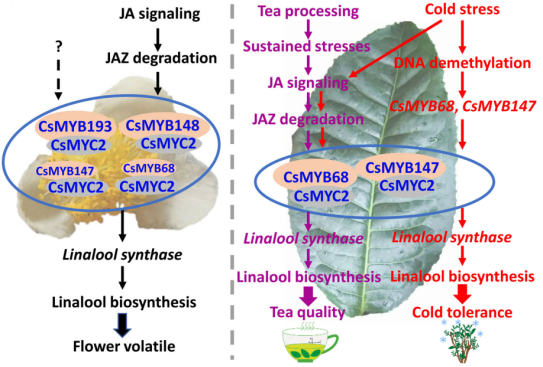
Figure 1. Schematic of the molecular mechanism by which the MYB–MYC2 complex regulates tea aroma formation and the tea plant response to cold stress
Anhui Agricultural University is the first affiliation and the corresponding affiliation. Professor Li Penghui and Professor Xia Enhua are co-corresponding authors. Master's students Yue Rui (graduated), Li Yaling and Qi Yujia are co-first authors of the paper. Associate Professor Tong Wei, Associate Researcher Si Xiongyuan, Dr. Zhang Yanrui and master's students Liang Xiaoyu, Zheng Ziqing and Ye Zhili made important contributions to the study. The research was supported by the National Natural Science Foundation of China and projects of the Anhui Provincial Department of Education and Department of Science and Technology.
Paper link: https://onlinelibrary.wiley.com/doi/full/10.1111/pbi.14598


 LATEST
RESEARCH
LATEST
RESEARCH