Recently, the team of Professor Zhang Zhaoliang published in the internationally renowned botany journal The Plant Cell a research paper entitled “The mitochondrial carrier CsTHS1 acts as a gatekeeper of theanine accumulation in late-spring new shoots of tea plants”. The study systematically revealed the molecular mechanism of theanine transport and degradation in tea plant spring new shoot cells, providing an important theoretical basis for improving late-spring tea quality through precise breeding and cultivation measures.
As a characteristic functional component of tea plants, theanine is not only the key taste substance determining the fresh and brisk taste of green tea (its content accounts for more than 50% of the total free amino acids in spring tea), but has also attracted much attention for health benefits such as relieving anxiety, promoting sleep and enhancing memory. Studies have found that theanine content in high-quality early-spring tea reaches about 2%, whereas in late-spring tea it decreases by more than 50%, leading to a marked decline in tea quality. Although the molecular basis of theanine synthesis and transport has been elucidated, the regulatory mechanism of its dynamic changes in cellular content — especially the organelle-level mechanism of theanine degradation in late-spring new shoots — remained a scientific blind spot.
Through a yeast mutant screening system, the team identified for the first time the key mitochondrial carrier CsTHS1, which functions in regulating intracellular theanine accumulation. Based on the scientific understanding that amino acid metabolism is mainly completed in mitochondria, the team proposed a breakthrough hypothesis: tea plants dynamically regulate theanine levels in new shoots by mediating the entry of theanine into the mitochondrial degradation system through a specific mitochondrial carrier. By constructing a multi-dimensional transport verification system, the researchers not only confirmed that CsTHS1 is the first mitochondrial carrier with theanine transport capability, but also found that its arginine residue at position 307 (R307) evolved from glycine (G) during evolution, and that this key amino acid substitution significantly enhanced the carrier's transport activity for theanine.
Notably, subcellular localization analysis confirmed that the theanine-hydrolysing enzyme CsGGT2 is specifically localized to mitochondria, providing key evidence for the “mitochondrial degradation of theanine” hypothesis. To dissect the molecular pathway of theanine degradation, the team innovatively constructed a CsTHS1–CsGGT2–CsGDH2.1 coordinated regulatory network model (Figure 1), revealing the complete pathway of theanine metabolism: CsTHS1 mediates the transport of theanine across the mitochondrial membrane into mitochondria, CsGGT2 catalyses the hydrolysis of theanine into glutamate and ethylamine, and CsGDH2.1 then catalyses the conversion of glutamate into α-ketoglutarate and NH3 (Figure 2).
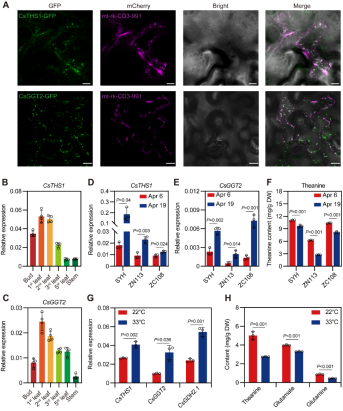
Figure 1. Subcellular localization of CsTHS1 and CsGGT2 and expression patterns of CsTHS1, CsGGT2 and CsGDH2.1 in tea plant new shoots
The expression of the three protein-coding genes increased significantly in late spring as temperature rose, promoting the transport and degradation of theanine into mitochondria (Figures 1 and 2). These findings explain the molecular mechanism behind the rapid decline of theanine in late spring, and also reveal an important biological mechanism by which tea plants provide a nitrogen source for the rapid growth of new shoots through dynamic regulation of theanine metabolism.
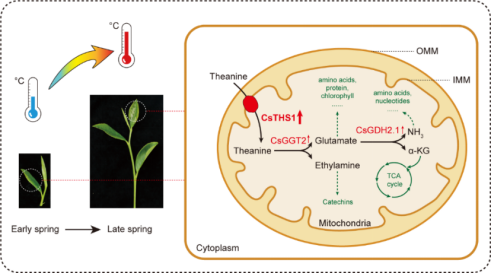
Figure 2. Molecular mechanism model of intracellular theanine transport and degradation in late-spring tea plant new shoots
Professor Zhang Zhaoliang of the National Key Laboratory of Tea Plant Germplasm Innovation and Resource Utilization, Anhui Agricultural University, is the corresponding author of this paper, and doctoral student Han Wenlong and master's graduate Ma Jingzhen are co-first authors. Professor Wan Xiaochun and Associate Professor Yang Tianyuan of the Key Laboratory, Professor William J. Lucas of the University of California, Davis, and Researcher Bao Shilai of the Institute of Genetics and Developmental Biology, Chinese Academy of Sciences, participated in the study. The research was supported by the National Key R&D Program and the National Natural Science Foundation of China. (Text and figures / Han Wenlong; editor / Guan Zhenyu; pre-review / Zhang Zhaoliang)


 LATEST
RESEARCH
LATEST
RESEARCH